JUNETEENTH, SANKOFA, AND THE URGENCY OF REMEMBERING WHO WE ARE
Looking Back to Move Forward
Juneteenth is not simply a day to remember slavery, emancipation, and the long struggle for freedom. It is a call to consciousness.
It is a reminder that freedom is not merely the absence of chains—it is the presence of identity, purpose, culture, and self-determination.
As we celebrate Juneteenth, we must ask ourselves a difficult question:
What good is physical freedom if we remain disconnected from who we are?
This is where the ancient African principle of Sankofa becomes more important than ever.
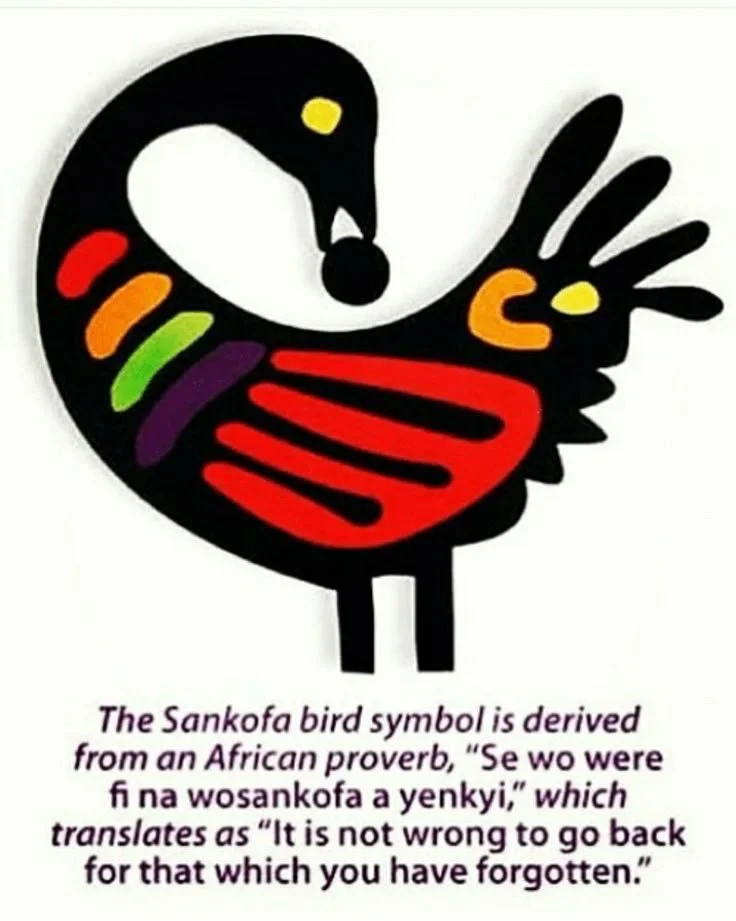
Sankofa, a word from the Akan people of Ghana, means "go back and fetch it." It is often symbolized by a bird moving forward while looking backward, carrying an egg on its back. The message is profound:
You cannot fully move into the future without reclaiming what was lost in the past.
This is not about living in yesterday.
It is about recovering the wisdom, values, stories, spirituality, and cultural knowledge necessary to build tomorrow.
The Cost of Cultural Amnesia
One of the greatest wounds inflicted upon enslaved Africans was not only physical bondage—it was cultural disconnection.
Names were taken.
Languages were taken.
Spiritual systems were demonized.
Family structures were disrupted.
History was rewritten.
Generations were taught to see themselves through the eyes of others.
The result is something we still witness today.
When people lose connection to culture, they often lose connection to purpose.
When communities lose connection to identity, they become vulnerable to confusion, exploitation, addiction, violence, hopelessness, and self-destruction.
A people without cultural grounding become easier to influence than to inspire.
Easier to consume than to create.
Easier to divide than to unite.
The absence of culture creates a vacuum, and that vacuum will always be filled by something.
If it is not filled by ancestral wisdom, it will often be filled by addiction.
If it is not filled by community, it will be filled by isolation.
If it is not filled by purpose, it will be filled by distraction.
Addiction, Mental Health, and the Search for Identity
In my work as a counselor, I see people every day who are not only struggling with substances but struggling with meaning.
Many addictions are not simply chemical problems.
They are spiritual wounds.
They are identity wounds.
They are community wounds.
People often use substances to numb pain, silence anxiety, escape trauma, or fill an emptiness they cannot name.
Yet beneath many of these struggles lies a deeper question:
Who am I?
And equally important:
Where do I belong?
When people know their story, understand their heritage, and feel connected to something greater than themselves, resilience increases.
Hope increases.
Purpose increases.
Recovery becomes more than abstinence—it becomes transformation.
Mental health cannot be separated from culture.
Healing cannot be separated from identity.
A person who knows where they come from is better equipped to decide where they are going.
The Spiritual Dimension of Sankofa
Sankofa is more than history.
It is spiritual responsibility.
Many African traditions teach that those who came before us are not truly gone. Their sacrifices, lessons, wisdom, and prayers continue to shape the living.
Our ancestors endured unimaginable hardship so future generations could have opportunities they never experienced.
The question is not whether they suffered.
The question is whether we will honor that suffering with purpose.
Will we build?
Will we heal?
Will we remember?
Or will we become so distracted by modern noise that we forget the foundations that made our existence possible?
Every generation receives an inheritance.
Not all inheritances are financial.
Some inherit courage.
Some inherit resilience.
Some inherit faith.
Some inherit unfinished work.
Sankofa teaches us to retrieve these gifts and carry them forward.
Culture Is Not a Luxury—It Is a Necessity
Some people view culture as entertainment.
A holiday.
A museum exhibit.
A food festival.
A dance performance.
Culture is far more than that.
Culture teaches values.
Culture teaches responsibility.
Culture teaches belonging.
Culture teaches children who they are before the world attempts to tell them otherwise.
Culture provides a map.
Without a map, people wander.
Without direction, people drift.
Without roots, people become vulnerable to every passing trend, ideology, and distraction.
A tree without roots cannot survive a storm.
A people without roots cannot withstand social, psychological, and spiritual storms.
The Future Requires More Than Remembrance
Juneteenth should never be reduced to a history lesson.
It should be a strategy session.
The future demands more than remembrance.
It demands action.
We must invest in our communities.
We must support mental health.
We must address addiction with compassion and accountability.
We must strengthen families.
We must teach accurate history.
We must preserve culture.
We must create economic opportunities.
We must build institutions that serve future generations.
Most importantly, we must raise children who understand that their identity is not defined by oppression but by possibility.
A Juneteenth Challenge
As we celebrate Juneteenth, let us do more than remember freedom.
Let us define it.
Let us recognize that true liberation includes mental freedom, spiritual freedom, cultural freedom, economic freedom, and emotional freedom.
Let us practice Sankofa by reclaiming the wisdom that was nearly lost.
Not to dwell in the past.
Not to romanticize history.
But to build a future rooted in truth.
The ancestors looked forward and saw us.
Now we must look backward, retrieve the lessons they left behind, and continue the journey.
Because Sankofa reminds us of an eternal truth:
The future belongs to those who know where they come from.
And in a world increasingly disconnected from meaning, culture may be one of the most powerful medicines we have left.